Engineering
internal production
An agent SDLC that one person runs: a spec goes in, a reviewed pull request comes out.
the process, in the client's words
We have a backlog of small, well-described changes. We want them built, reviewed and released without a developer babysitting each one, and a human only where money or production is touched.
where the agent sits
- spec merged as its own pull request
- round on a runner: plan, then implement
- review by a different vendor's model
- verify, then a pull request back
- human approval
- release cut by the line
the gate
Cross-vendor review is the gate: a reviewer from the same model family blocks nothing, a rival vendor blocks nearly half. The merge flow is CI-aware, and the write rail refuses an unknown token outright rather than writing something it cannot attribute.
what the human approves
Every merge, every deploy, every publication.
470+spec documents
~140klines of TypeScript
0% / 43%same-family vs rival blocking
147commits in one release, cut by the line
What it does not do. The factory itself is private. These pages show counted facts, never the code.
the loop, drawn · the coordinating session
Trust Ladder
internal production · synthetic data
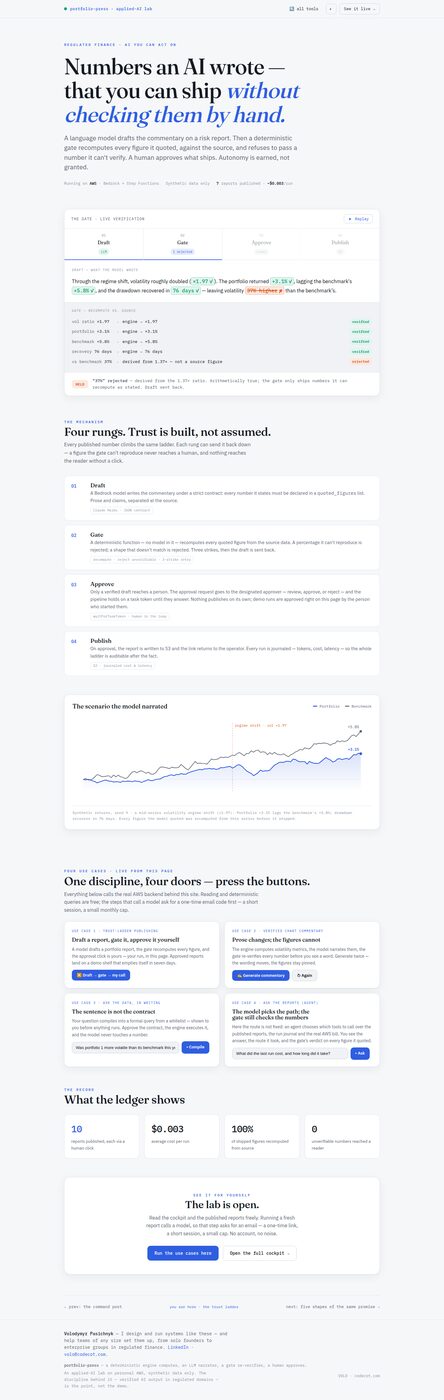
A publishing pipeline that releases no document without a human decision.
the process, in the client's words
The portfolio report goes to the client only after a named person approved it, and no number in it can be unverifiable.
where the agent sits
- a model drafts from source data
- a gate recounts every figure
- the pipeline waits on a human
- publish
- journal the cost and the outcome
the gate
A deterministic function with no model in it recounts every claimed number against the source, checks the document's shape and that the shares add up. What does not reproduce goes back to the model with the reason. Three strikes. Three things can refuse: the gate, the person, and the clock.
what the human approves
Publication. One button, after which the document leaves.
11 / 10runs / published
1expired unanswered and published nothing
$0.0030per run
What it does not do. The gate checks that numbers reproduce, not that the conclusion is useful. A correct set of figures in a pointless paragraph passes.
the method, live
Iren Miel
demo brand · openly AI-run
A fashion brand whose model line, content and storefront are produced by agents, with one human gate.

the process, in the client's words
We need products and content for a storefront and socials, with nothing to photograph and no budget to photograph it.
where the agent sits
- an intake bot collects finds
- a draft card is written in the brand voice
- the catalogue holds the canon
- photography is generated locally
- a publish task builds and deploys the storefront
the gate
The bot stores nothing from strangers. Every draft is approved, edited or rejected before it can move, only a ready package ships, images over the size limit are refused, and the runner may only touch allowed paths.
what the human approves
Keep or discard a find, approve a draft and set its price, move it to ready, publish.
16packages ready
53frames produced
$0 – 0.08per package, 10 to 20 minutes
4 of 6designs recoloured by the human
What it does not do. The publishing runner has not had a live run yet, and face consistency still needs a cloud model, so the fully-local claim does not hold everywhere.
Astro on Tap
internal production · live, small audience
A deterministic engine computes, a model speaks: a daily forecast published as video, site and posts.

the process, in the client's words
Every morning a forecast of the day, as a clip with voice and captions, plus a site in four languages. Monthly, one clip per sign. Weekly, one general post.
where the agent sits
- ephemeris positions computed
- a text draft with a self-checking retry loop
- voice generated
- the voice is transcribed back and compared
- captions and render
- release to site, then channels, on timers
the gate
The finished audio is transcribed by a second model and word-diffed against the source text. One inserted word rejects the take. Two takes, then the release stops and raises an alarm rather than shipping. Every clock time in the text must exist in the engine's event list.
what the human approves
Silence before the deadline is consent, and the human can hold, skip or publish now; uploads to video channels run only from his own timer.
39 + 12 + 1daily, monthly and weekly episodes published
$0.15median model cost per day, $6.49 over 35 days
3 of 41days failed and shipped nothing
What it does not do. The audience is small and new. The discipline of the pipeline is the point here, not the view count.
DAMW
internal production · live
Anime shorts for a concept album: from a track and a storyboard to a published vertical clip.

the process, in the client's words
From a track and a storyboard to a published clip: story, frames, beat sync, assembly, publish.
where the agent sits
- storyboard
- frame generation
- a beat grid computed from the audio
- assembly on the beat grid
- publication drafts
the gate
The storyboard is approved before a single frame is generated. Every frame is checked against the cast canon, and a drifted character is regenerated by tag rather than accepted. Durations come only from the computed beat grid, because doing that arithmetic by hand once produced a clip two seconds short.
what the human approves
Storyboard, frame contact sheets, the final clip, and the publication itself.
2clips shipped
19 of 22shortlisted frames accepted
$0spend, local hardware
What it does not do. These are animatics built from stills and motion, not generated video. Character consistency is held by human review and a growing list of negatives.
Baltic Vibes
internal production
A production line for music clips and short animatics for a network of channels.

the process, in the client's words
A clip for a song, from the audio file to an upload-ready video with its metadata. And a thirty-second animatic from a track, with subtitles.
where the agent sits
- timings from the audio
- storyboard
- cast canon
- frame generation
- compositing of the complex shots
- upscale
- assembly with sound and subtitles
- technical acceptance
- publication package
the gate
A contact sheet is taken from the finished video and checked. Loudness is measured against a target rather than eyeballed. A frame where the character canon drifted, or the shot is wrong, is regenerated rather than accepted.
what the human approves
The storyboard before generation, the frame checklist before assembly, and the final video.
12masters produced in two weeks
7 of 33generated frames accepted for the short
4 minfrom audio file to master on one clip
What it does not do. Multi-character scenes do not come out of direct generation and have to be composited. Camera motion over stills jitters, so static shots are the default.
Household finance recorder
internal production · audience of one
A recorder of household financial operations: photograph a document, and the books propose the entries.
the process, in the client's words
Photograph a receipt or a banking screen from the phone, and the books propose the missing entries. Monthly totals that match the spreadsheet I keep today.
where the agent sits
- a document is shared from the phone
- a local vision model reads it, and nothing leaves the machine
- candidate entries are extracted
- each is matched against what is already recorded
- the person confirms
- the ledger, the envelopes and the daily allowance update
the gate
Candidates are matched against recorded entries and earlier proposals before anything is shown, so the same document cannot be booked twice. A candidate that names no account asks instead of guessing. Nothing is written without a tick. The release bar is that monthly totals equal the workbook's, or the difference is explained in writing.
what the human approves
Every entry and its category, every balance observation, and both legs of every transfer.
47private financial documents read since 30 August
223ledger entries created from them
15 of 287candidates dismissed
465tests green
What it does not do. The vision model shares a single graphics card. When other work holds it, reading one document takes about two minutes on the processor instead.
Story Rails
internal production · pre-pilot
A production line for story-driven video channels: from an idea to a published video, in any genre.
the process, in the client's words
Five historical shorts a week, the same characters, the same style, checked before anything is published.
where the agent sits
- brief
- story
- arc
- bible
- breakdown
- build
- acceptance
- publish
the gate
Every gate needs an explicit human yes, and silence is never consent. An unapproved shot list blocks generation, an unapproved contact sheet blocks animation, a failed voice check blocks assembly, an open acceptance line blocks release, and a duplicate or out-of-order push to a channel is refused.
what the human approves
The production card, the logline, the canon and the bible, the shot list, the contact sheet, the acceptance protocol, and each channel it goes to.
10specs merged
0pilots shipped
What it does not do. Nothing has shipped yet. The rails exist as contracts, and two of the task kinds are unimplemented.